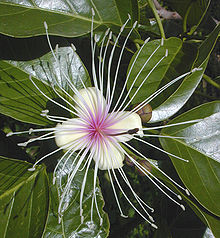
Flowers within art are also representative of the female genitalia,[30] as seen in the works of artists such as Georgia O'Keeffe, Imogen Cunningham, Veronica Ruiz de Velasco, and Judy Chicago, and in fact in Asian and western classical art. Many cultures around the world have a marked tendency to associate flowers with femininity.
The great variety of delicate and beautiful flowers has inspired the works of numerous poets, especially from the 18th-19th centuryRomantic era. Famous examples include William Wordsworth's I Wandered Lonely as a Cloud and William Blake's Ah! Sun-Flower.
Because of their varied and colorful appearance, flowers have long been a favorite subject of visual artists as well. Some of the most celebrated paintings from well-known painters are of flowers, such as Van Gogh's sunflowers series or Monet's water lilies. Flowers are also dried, freeze dried and pressed in order to create permanent, three-dimensional pieces of flower art.
Their symbolism in dreams has also been discussed, with possible interpretations including "blossoming potential".[31]
The Roman goddess of flowers, gardens, and the season of Spring is Flora. The Greek goddess of spring, flowers and nature is Chloris.
In Hindu mythology, flowers have a significant status. Vishnu, one of the three major gods in the Hindu system, is often depicted standing straight on a lotus flower.[32] Apart from the association with Vishnu, the Hindu tradition also considers the lotus to have spiritual significance.[33] For example, it figures in the Hindu stories of creation.[34]

Pollination


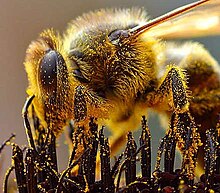
The primary purpose of a flower is reproduction. Since the flowers are the reproductive organs of plant, they mediate the joining of the sperm, contained within pollen, to the ovules — contained in the ovary. Pollination is the movement of pollen from the anthers to the stigma. The joining of the sperm to the ovules is called fertilization. Normally pollen is moved from one plant to another, but many plants are able to self pollinate. The fertilized ovules produce seeds that are the next generation. Sexual reproduction produces genetically unique offspring, allowing for adaptation. Flowers have specific designs which encourages the transfer of pollen from one plant to another of the same species. Many plants are dependent upon external factors for pollination, including: wind and animals, and especially insects. Even large animals such as birds, bats, and pygmy possums can be employed. The period of time during which this process can take place (the flower is fully expanded and functional) is called anthesis. The study of pollination by insects is calledanthecology.

The principal purpose of a flower is the reproduction of the individual and the species. All flowering plants are heterosporous, producing two types of spores. Microspores are produced by meiosis inside anthers while megaspores are produced inside ovules, inside an ovary. In fact, anthers typically consist of four microsporangia and an ovule is an integumented megasporangium. Both types of spores develop into gametophytes inside sporangia. As with all heterosporous plants, the gametophytes also develop inside the spores (are endosporic).
In the majority of species, individual flowers have both functional carpels and stamens. Botanists describe these flowers as being perfector bisexual and the species as hermaphroditic. Some flowers lack one or the other reproductive organ and called imperfect or unisexual. If unisex flowers are found on the same individual plant but in different locations, the species is said to be monoecious. If each type of unisex flower is found only on separate individuals, the plant is dioecious.

Structure

Although the arrangement described above is considered "typical", plant species show a wide variation in floral structure.[1]These modifications have significance in the evolution of flowering plants and are used extensively by botanists to establish relationships among plant species.
The four main parts of a flower are generally defined by their positions on the receptacle and not by their function. Many flowers lack some parts or parts may be modified into other functions and/or look like what is typically another part. In some families, like Ranunculaceae, the petals are greatly reduced and in many species the sepals are colorful and petal-like. Other flowers have modified stamens that are petal-like; the double flowers of Peonies and Roses are mostly petaloid stamens.[2] Flowers show great variation and plant scientists describe this variation in a systematic way to identify and distinguish species.
Specific terminology is used to describe flowers and their parts. Many flower parts are fused together; fused parts originating from the same whorl are connate, while fused parts originating from different whorls are adnate; parts that are not fused are free. When petals are fused into a tube or ring that falls away as a single unit, they are sympetalous (also calledgamopetalous). Connate petals may have distinctive regions: the cylindrical base is the tube, the expanding region is the throat and the flaring outer region is the limb. A sympetalous flower, with bilateral symmetry with an upper and lower lip, isbilabiate. Flowers with connate petals or sepals may have various shaped corolla or calyx, including campanulate, funnelform, tubular, urceolate, salverform or rotate.
Referring to "fusion," as it is commonly done, appears questionable because at least some of the processes involved may be non-fusion processes. For example, the addition of intercalary growth at or below the base of the primordia of floral appendages such as sepals, petals, stamens and carpels may lead to a common base that is not the result of fusion.[3][4][5]
Left: A normal zygomorphic Streptocarpus flower. Right: An aberrant peloric Streptocarpus flower. Both of these flowers appeared on the Streptocarpus hybrid 'Anderson's Crows' Wings'.
Many flowers have a symmetry. When the perianth is bisected through the central axis from any point, symmetrical halves are produced, forming a radial symmetry. These flowers are also known to be actinomorphic or regular, e.g. rose or trillium. When flowers are bisected and produce only one line that produces symmetrical halves the flower is said to be irregular orzygomorphic, e.g. snapdragon or most orchids.
Flowers may be directly attached to the plant at their base (sessile—the supporting stalk or stem is highly reduced or absent). The stem or stalk subtending a flower is called a peduncle. If a peduncle supports more than one flower, the stems connecting each flower to the main axis are called pedicels. The apex of a flowering stem forms a terminal swelling which is called the torus or receptacle.
A flower, sometimes known as a bloom or blossom, is the reproductive structure found in plants that are floral (plants of the divisionMagnoliophyta, also called angiosperms). The biological function of a flower is to effect reproduction, usually by providing a mechanism for the union of sperm with eggs. Flowers may facilitate outcrossing (fusion of sperm and eggs from different individuals in a population) or allow selfing (fusion of sperm and egg from the same flower). Some flowers produce diaspores without fertilization (parthenocarpy). Flowers contain sporangia and are the site where gametophytes develop. Many flowers have evolved to be attractive to animals, so as to cause them to be vectors for the transfer of pollen. After fertilization, the ovary of the flower develops into fruit containing seeds.
In addition to facilitating the reproduction of flowering plants, flowers have long been admired and used by humans to beautify their environment, and also as objects of romance, ritual, religion, medicine and as a source of food.